Drop the Beat, Tell the Story: How Medellín's Music Became Cinema's Most Powerful Narrator
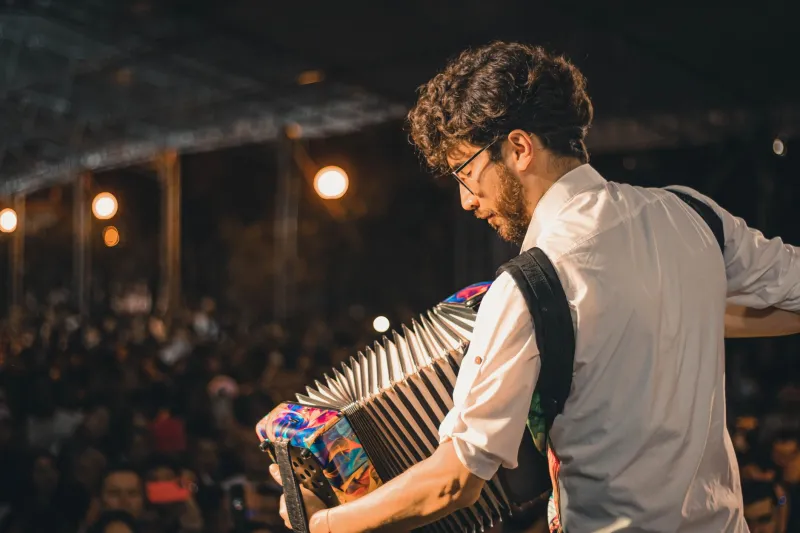
There's a moment in a certain kind of Medellín film — you'll know it when you hear it — where the vallenato accordion creeps in low under a conversation that's going badly. Nobody raises their voice. Nobody has to. The music already told you everything about where this scene is headed. That's not accident. That's architecture.
For too long, the conversation about Latin American cinema focused almost entirely on what audiences could see: the steep hillside comunas, the neon-lit streets, the faces weathered by decades of a city refusing to break. And those visuals deserve every word written about them. But there's an equally sophisticated revolution happening in the headphones, in the theater speakers, in the Dolby Atmos rigs of streaming platforms finally investing in Colombian content. The music in Medellín-set films has quietly evolved from set dressing into something closer to a second screenplay.
When the Rhythm Knows More Than the Character Does
Composers working in Colombian cinema will tell you something that sounds almost mystical until you think about it: music in Medellín doesn't just reflect emotion — it anticipates it. Traditional cumbia, with its African-Indigenous fusion roots and that distinctive circular percussion pattern, carries centuries of communal memory. When a director drops a cumbia cue over a scene of displacement or homecoming, they're not just setting a mood. They're invoking a shared cultural history that any Colombian viewer feels in their chest.
The challenge — and the opportunity — for US audiences is learning to receive that information without a translation key. And increasingly, they are. Streaming platforms have noticed that viewers who start watching Colombian films stick around for the music. Playlists generated from film soundtracks on Spotify have introduced American listeners to artists they'd never have discovered through traditional radio channels. The pipeline from cinema to cultural curiosity runs directly through the speakers.
Directors making films in and about Medellín are acutely aware of this dynamic. The creative decision to lead with traditional instrumentation versus contemporary production — or to braid them together — is never casual. It's a statement about whose story is being told and for whom.
Reggaeton as Emotional Architecture
Let's talk about reggaeton, because it gets flattened in American cultural conversation into something purely about clubs and summer playlists. In Medellín's cinema, the genre does something far more complicated. Because reggaeton emerged from working-class Latin communities — in Puerto Rico, yes, but absorbed and mutated across Colombia with genuine local identity — its presence in a film carries class and geography encoded in the beat.
When a director scores a scene of young men from a lower barrio with a hard reggaeton track, they're not just establishing coolness or danger. They're making an argument about economic geography. The music announces: these characters exist in a specific relationship to power, to money, to the city that keeps them at its edges. An American viewer who's only encountered reggaeton as party music has to recalibrate. And the best films force that recalibration without explaining it — they trust the audience to catch up.
Composers who blend live instrumentation with dembow rhythms — the foundational reggaeton beat pattern — are creating something genuinely new. A brass section playing over a dembow groove in a film about Medellín's transformation isn't a quirky production choice. It's a thesis statement about a city holding its past and present in the same breath.
Vallenato's Grief Work
If reggaeton maps class and geography, vallenato maps grief. That's a simplification, but not an unfair one. The accordion-driven music from Colombia's Caribbean coast has a mournfulness baked into its DNA — even its upbeat songs carry a kind of longing. Directors working through Medellín's complicated relationship with violence and loss reach for vallenato the way a novelist reaches for a particular word that means something beyond its dictionary definition.
Audio designers on these productions describe the challenge of integrating vallenato authentically — not as local color, not as the sonic equivalent of a tourism poster, but as genuine emotional text. The accordion line that enters when a character learns someone has died isn't there to tell you to be sad. It's there to locate that sadness within a specific Colombian cultural experience of mourning, one that has its own rituals, its own sounds, its own way of moving through loss.
For US audiences encountering this for the first time, there can be a beautiful disorientation. The music feels emotionally legible — you know you're supposed to feel something — but the specific cultural register is unfamiliar. That gap, rather than being a barrier, becomes a doorway. Viewers start asking questions. They start listening differently.
The Composer's Invisible Hand
The composers doing this work are rarely household names in the United States, and that's worth naming directly because it reflects a broader pattern of whose creative labor gets credited in international cinema conversations. The music supervisors and original score composers on Colombian productions are making decisions of enormous narrative consequence — decisions that shape how a film lands emotionally, how it travels across cultural contexts, how it gets remembered.
When a film about Medellín reaches American audiences and generates genuine emotional response — when viewers say they were moved in ways they didn't expect — the acting and direction rightfully get discussed. The composers, often working with budgets a fraction of what Hollywood would allocate, rarely get the same spotlight. This is changing slowly, as streaming platforms create more visible credits infrastructure and as music journalism starts covering film scores with the same seriousness it gives albums.
But the gap remains real, and closing it matters — both for recognizing the artists doing this work and for helping audiences understand why these films hit differently.
What US Audiences Are Actually Hearing
Here's the interesting thing happening right now: American viewers are discovering Latin American cinema partly through its sound. Not through critical essays or word-of-mouth recommendations, but through the experience of watching a film and thinking, what is that? Who made that music? Where can I find more of it?
That's the secret weapon finally revealing itself. Medellín's music scene — its living, contemporary artists as much as its traditional forms — has been feeding cinema with material of extraordinary richness. And cinema has been feeding those artists back to global audiences with the emotional context that makes the music land with full force.
The loop is closing. The city that learned to tell its own story visually is now insisting that you listen, too. And the US audience that finally showed up for subtitles is discovering that the most important things in these films might not need translation at all — they need only speakers good enough to carry the weight of what Medellín's composers are putting into them.
Turn it up. The story's in the beat.