Almost Isn't Enough: How Latin American Films Keep Losing the Oscar Game Before It Even Starts

Every awards season, the same thing happens. A Colombian film gets a standing ovation at a major festival. Critics write breathless reviews. Social media lights up. And then, somewhere between the applause and the nomination announcement, it just... disappears. Not because the film was bad. Not because audiences didn't connect. But because the machinery that decides what gets remembered — and what gets awarded — runs on a very specific kind of fuel, and Latin American cinema rarely has access to the pump.
This isn't a story about quality. This is a story about infrastructure, politics, and a race that some films enter already half a lap behind.
The Invisible Bracket
The International Feature Film category at the Academy Awards is supposed to be the great equalizer — the room where cinema from everywhere gets a seat at the table. In practice, it functions more like a tiered system with some very clear favorites. European cinema, particularly from France, Germany, and Scandinavia, has historically dominated the conversation. Even when a Latin American film breaks through — Alfonso Cuarón's Roma, Pablo Larraín's work, a handful of others — it tends to be the exception that proves an uncomfortable rule.
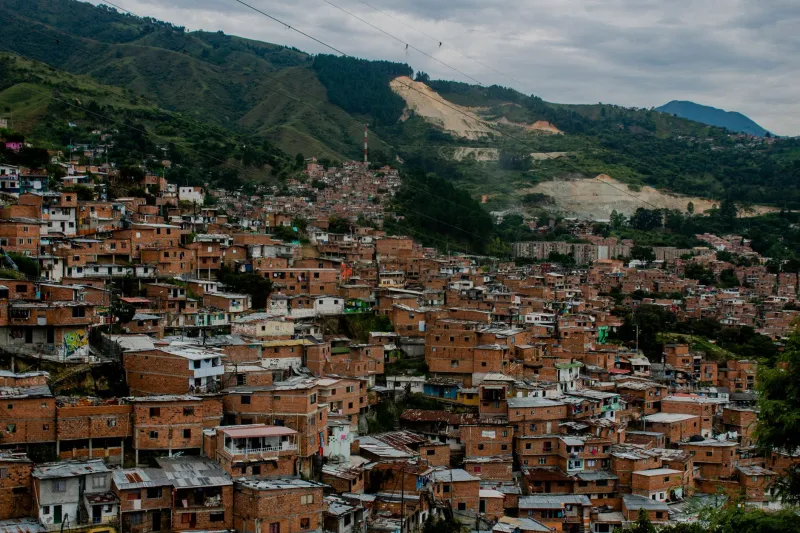
For Colombian films specifically, and Medellín productions in particular, the challenge isn't just competing against the world. It's competing against a perception problem that the industry has never fully confronted. When evaluators and voters think "prestige international cinema," Medellín still fights against decades of reductive imagery — cartel narratives, trauma porn, the Escobar shadow that refuses to lift. A film that doesn't fit that mold can feel, to the uninitiated voter, like it doesn't belong in the conversation at all.
That's the invisible bracket. Not quite genre, not quite geography — just a vague sense that certain stories are "for" awards and others aren't.
The Festival Entry Point Problem
Here's where it gets structural. To even be considered for an Oscar in the International Feature category, a film has to be submitted by its home country — one film per nation, per year. Colombia's selection committee has the unenviable job of picking a single title to represent an entire country's cinematic output. That process alone is a political minefield.
But even after selection, the work is just beginning. The campaign that follows — the screenings for Academy members, the trade press coverage, the strategically placed profiles in Variety and The Hollywood Reporter — costs money. Real money. The kind that studios and distributors with deep pockets spend to keep their films top of mind during a voting window that lasts weeks.
Independent Colombian productions, even extraordinary ones, often can't play that game. They might land a US distributor willing to give them a limited theatrical run, but without the marketing infrastructure to sustain visibility through the full awards cycle, they fade. Voters forget. The film slips.
This isn't hypothetical. It's a pattern that repeats with enough regularity to be called a system.
Falling Between the Cracks
There's a particular kind of purgatory that some Latin American films end up in — too polished and internationally minded to be dismissed as "raw" or "regional," but not backed by enough institutional weight to be treated as serious contenders. They occupy a middle space where praise is abundant but traction is elusive.
Films from Medellín often land here. The city's filmmaking community has matured significantly over the past decade. The technical craft is there. The storytelling ambition is there. What's missing is the connective tissue between the film and the decision-makers — the agents, the publicists, the Oscar consultants who know which screeners to send and which parties to attend during the Academy's calendar.
And when a film can't afford that connective tissue, it relies on critical momentum alone. Critical momentum is real, but it doesn't vote.
The Streaming Wildcard
The rise of streaming platforms has shuffled the deck in ways that are still playing out. Netflix's investment in Roma showed what was possible when a platform throws its full weight behind a Latin American film during awards season. The result was historic — three Oscars, including Best Director and Best Cinematography. But Roma was also a special case: a Mexican director already beloved by Hollywood, a black-and-white art film that read as prestige from every angle, and a platform with essentially unlimited promotional resources.
For Colombian films on smaller streaming platforms, or those distributed through regional deals that don't include major US streamers, the calculus is different. Availability matters enormously. If a US-based Academy voter can't easily find a film — can't pull it up on a platform they already use — the chances of them watching it drop significantly. Accessibility isn't just a nice-to-have. In awards politics, it's close to everything.
The good news is that the streaming landscape keeps shifting. More platforms are acquiring Latin American content. More Colombian productions are finding US distribution pathways that didn't exist five years ago. The infrastructure is building — slowly, but it's building.
What Would Actually Change Things
The honest answer is that fixing this requires pressure from multiple directions at once.
First, Colombia's film industry needs more robust support for the awards campaign process — not just the production side, but the visibility side. ProColombia and Proimágenes do important work, but the gap between a great film and a competitive awards campaign still requires resources that most independent productions can't self-generate.
Second, the Academy itself needs to keep evolving. The expansion of international membership over the past several years has already begun to shift which films get recognized. More voters from Latin America, Africa, and Southeast Asia means more films from those regions get seen, discussed, and remembered when ballots open. That's not a small thing.
Third — and maybe most importantly — US audiences have a role to play. When American viewers actively seek out Colombian cinema, when they write about it, recommend it, and stream it in numbers that platforms can measure, it sends a signal that distributors and studios read clearly. Demand creates investment. Investment creates campaigns. Campaigns create nominations.
The Film Is Not the Problem
If there's one thing worth saying plainly, it's this: the Colombian films being left out of the Oscar conversation aren't being left out because they're not good enough. Some of the most emotionally precise, visually inventive, and culturally necessary cinema being made anywhere right now is coming out of Medellín and the broader Colombian film ecosystem.
The problem is a game with rules written by people who weren't thinking about Medellín when they wrote them. And the only way to change that is to keep making great films, keep building the infrastructure around them, and keep pushing until the game has to adjust.
Almost isn't enough. But almost, done consistently and loudly enough, has a way of becoming something more.