Reading the Room: How American Audiences Fell for Subtitles — and Changed Latin Cinema Forever

For a long time, the conventional wisdom in Hollywood was pretty firm: American audiences don't do subtitles. They tolerate them for awards season prestige, sure. They'll sit through a Parasite or a Roma when the cultural moment demands it. But as a commercial proposition — as something you could actually build a release strategy around — foreign-language film was considered a niche product for a niche audience.
That conventional wisdom is currently being dismantled in real time, and the people feeling it most acutely aren't in Los Angeles. They're in Bogotá, Medellín, and Mexico City, sitting in development meetings where projects that would have been dead on arrival five years ago are suddenly getting greenlit.
The Numbers That Changed the Conversation
Streaming didn't just give Latin American cinema a distribution channel. It gave the industry something it had never really had before: granular data on what American audiences actually watch when nobody's watching them make the choice.
And what that data shows is genuinely surprising to people who held the old assumptions. Netflix's internal viewership numbers — the ones they've selectively made public, along with the patterns that leak out through industry reporting — consistently show Spanish-language content outperforming expectations in the US market. Not just in Latino households, though the numbers there are significant. Across demographics. Across age groups. Across regions that nobody would have predicted were hungry for a Colombian crime drama or a Mexican family saga.
The working theory among distributors is that streaming removed the friction. Going to an art house theater to see a subtitled film requires a kind of deliberate cultural commitment that most people don't make casually. Pressing play on your couch is a completely different psychological transaction. When the barrier dropped, the appetite that was always there became visible.
What Producers in Colombia Started Noticing
The shift in US viewership didn't stay abstract for long. Colombian producers and distributors began seeing it in concrete ways: in the conversations they were having with international co-production partners, in the terms being offered for streaming rights, and in the kinds of stories that were suddenly being described as commercially viable.
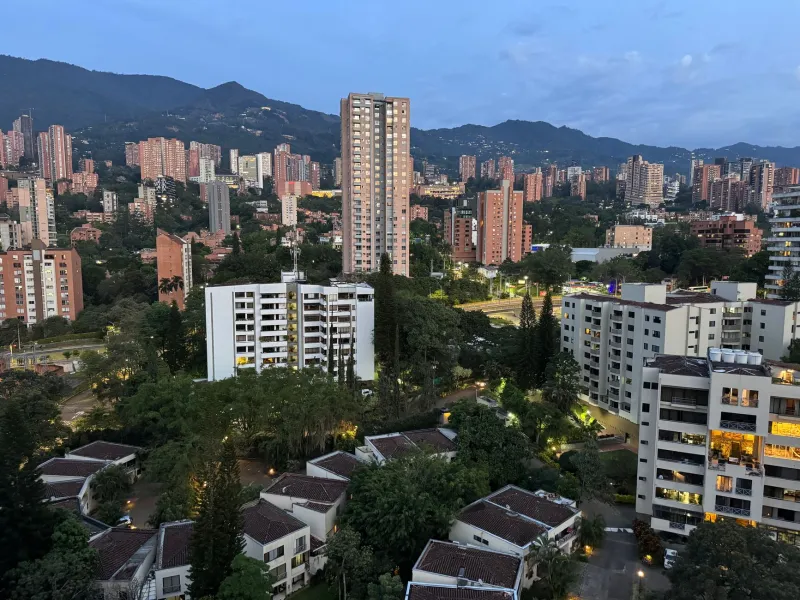
Producers working on projects set in Medellín describe a before-and-after moment that's hard to pin to a single title but feels real nonetheless. Before, pitching a story rooted in the specific social geography of the comunas — in the textures of life in a particular neighborhood, told in local dialect, with a cast of unknowns — meant fighting an uphill battle about marketability. The notes would come back asking for more universal entry points, which was often code for less specificity, less Colombia.
Now those same projects are being described as strengths rather than liabilities. The specificity is the pitch. The localness is the selling point. Because the data shows that audiences who found their way to subtitled Latin content through a gateway show didn't stop there — they kept watching, kept seeking out more, and developed genuine literacy in the region's storytelling traditions.
The Feedback Loop Nobody Planned
What's emerged is a feedback loop that nobody designed but everyone is now trying to understand and accelerate. American audiences watch more Latin American content. Streaming platforms see the numbers and commission more. Bigger commissions attract bigger budgets and more ambitious projects. More ambitious projects reach broader audiences and bring in new viewers. Those viewers develop more sophisticated taste and appetite for content that would previously have been considered too regional, too specific, too local.
And at each turn of that loop, the stories getting made get a little bolder.
This is showing up in casting decisions in interesting ways. There's been a notable shift away from the old practice of casting recognizable American or European actors in lead roles in Latin American productions — a strategy that was explicitly designed to make projects more legible to US buyers. That calculation is changing. Colombian actors with no name recognition in the US are headlining projects that are being acquired for major platforms, because the platforms have learned that their audiences will follow a story rather than a face.
For Medellín specifically, this has meant something significant: the city's own actors, speaking in their own voices, telling stories rooted in their own experience, are now commercially viable in a way that requires no translation beyond the literal one at the bottom of the screen.
The Parasite Effect, Latin Edition
It would be too simple to say that Bong Joon-ho's Oscar sweep opened the door for Latin American cinema in the US. But it would also be dishonest to pretend it didn't matter. Parasite demonstrated to a mainstream American audience — not just the awards circuit, but the people who watched it on Hulu with their families — that a non-English-language film could be viscerally entertaining, emotionally devastating, and completely accessible. It reframed subtitles as a feature rather than a bug.
Latin American filmmakers watched that moment carefully. And what several Colombian directors and producers have said publicly since is that it changed the pitch meetings. Not because Hollywood suddenly became interested in Latin cinema — that interest existed before — but because the conversation about what American audiences could handle shifted. The ceiling moved.
What Gets Made Next
The most consequential effect of this shift might not be the projects that are getting made right now but the ones being developed for three or four years from now. Development pipelines are long, and the projects entering them today reflect a set of assumptions about audience appetite that would have seemed wildly optimistic a decade ago.
In Colombia, that means stories that dig deeper into regional specificity rather than softening it. It means filmmakers from Medellín's comunas getting development deals for projects that center their own communities' perspectives without the mediating layer of an outside protagonist. It means genre films — thrillers, horror, romantic comedies — being made in Spanish for Spanish-speaking characters, without the assumption that they need an American anchor to travel.
The subtitle, it turns out, was never really the problem. The problem was an industry that had stopped trusting audiences to be curious. American viewers fixed that by being curious anyway, one streaming session at a time. And now the films being made in response to that curiosity are getting genuinely interesting.
Medellín has a lot of stories left to tell. The audience is finally ready to read them.