No More Excuses: Why American Audiences Are Finally Showing Up for Latin Cinema

Let's be honest about something. The 'subtitles are a dealbreaker' crowd has been losing ground for a while now, and not entirely because of some grand cultural awakening. A lot of it came down to boredom, algorithms, and a pandemic that left people with nothing but time and a streaming queue that kept surfacing things they'd normally scroll past. But whatever the entry point, the outcome is real: American viewers are watching Latin American films in numbers that would have seemed unlikely even five years ago. The question worth asking isn't just why — it's whether this moment represents a genuine shift in how the US engages with global cinema, or whether we're watching a trend that'll fade the moment the next superhero franchise drops.
The Algorithm Did Something Right for Once
Streaming platforms don't get a lot of credit for cultural good, and honestly, most of it is earned skepticism. But in this specific case, the recommendation engine turned out to be a surprisingly effective ambassador for Latin American cinema. When Squid Game proved that a non-English language series could dominate American pop culture conversation, it didn't just win Netflix a record viewership number — it recalibrated what the algorithm was willing to surface. Suddenly, 'foreign language' stopped functioning as a buried filter category and started being treated as a signal of quality.
Latin American content benefited from that recalibration directly. Films and series from Colombia, Mexico, Brazil, and Argentina began appearing in prominent shelf positions on major platforms — not tucked into a 'World Cinema' ghetto, but recommended alongside English-language content to audiences who had never actively sought them out. Passive discovery is a powerful thing. Plenty of viewers who would never have typed 'Colombian drama' into a search bar found themselves forty minutes into one because Netflix put it in front of them at the right moment.
A Generation That Grew Up Differently
The algorithmic shift would mean a lot less if it hadn't landed on fertile ground. Millennials and Gen Z in the US have grown up in a media environment that is fundamentally more global than anything previous generations experienced. Anime normalized subtitles for an enormous swath of young Americans before they were old enough to have strong opinions about it. K-pop built dedicated fanbases that actively sought out untranslated content as a point of cultural engagement rather than a barrier to entry. The idea that you have to share a language with something to love it has simply eroded.
Add to that the demographic reality of the US itself. The Latino population in America is enormous, growing, and increasingly visible as a cultural force — and it has always had an appetite for Latin American cinema that mainstream industry metrics consistently undercounted. What's new isn't the audience existing; it's the industry finally building infrastructure around it.
Authenticity as a Competitive Advantage
There's also something happening at the level of taste. A meaningful segment of American viewers — particularly younger ones — have developed a genuine fatigue with the polished, franchise-driven, IP-recycled product that dominates Hollywood output. When everything feels like it was engineered by committee to offend nobody and surprise nobody, a film that takes actual risks starts to look extraordinary by comparison.
Latin American cinema, and Colombian cinema specifically, has been operating in a space where risk-taking is less of a choice and more of a necessity. Without the safety net of nine-figure budgets and built-in franchise audiences, filmmakers have to make movies that mean something. The specificity of place and character that emerges from that constraint — stories rooted in particular streets, particular histories, particular ways of moving through the world — reads as authenticity to audiences who've been marinating in content that could have been set anywhere.
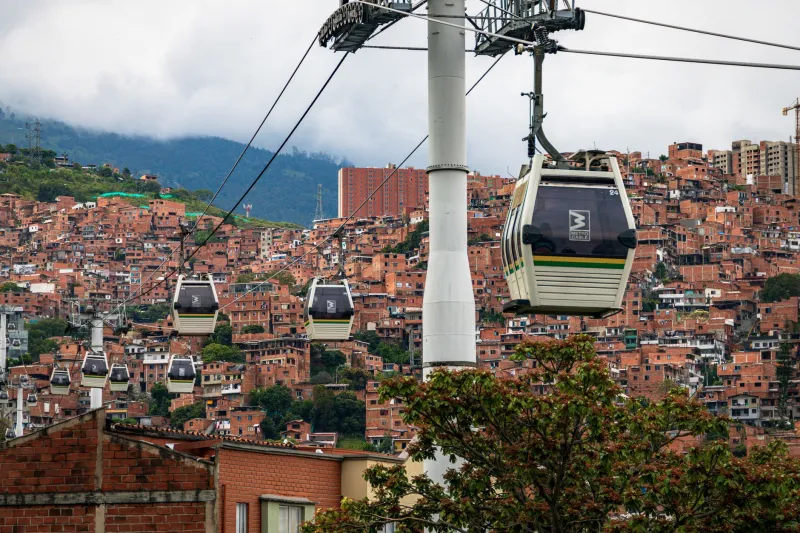
Medellín, in particular, has become a kind of proof-of-concept for this dynamic. Films emerging from that city carry a texture and urgency that is genuinely hard to manufacture. American audiences who find their way to them often describe the experience as a reminder of what movies can feel like when they're not primarily trying to protect a brand.
What the Studios Are (and Aren't) Getting Right
Hollywood's response to this moment has been characteristically mixed. On one hand, there's been a genuine increase in investment in Latin American content — more co-productions, more acquisition deals at festivals, more Spanish-language originals getting real marketing budgets. On the other hand, a lot of that investment still comes with strings attached: pressure to cast recognizable names, to soften endings, to make the story legible to the broadest possible audience.
The tension there is real. The thing that makes Latin American cinema compelling to American audiences right now is precisely its refusal to be smoothed out. When studios attempt to replicate that quality by producing their own version of it, they often end up with something that looks the part but has had the nerve removed. The filmmakers who navigate this most successfully tend to be the ones who've built enough of a reputation — through festival recognition, critical attention, community support — to negotiate from a position of some strength.
Trend or Turning Point?
Here's the honest answer: probably both, depending on what you're measuring. The superficial version of this moment — studios chasing a demographic, algorithms optimizing for novelty — almost certainly has a shelf life. Trends don't tend to sustain themselves on trend energy alone.
But underneath the trend, something structural has changed. The infrastructure for distributing and marketing Latin American film in the US is more developed than it's ever been. The audience that has discovered this cinema through streaming isn't going to un-discover it. And the filmmakers who've built international profiles during this window have leverage and visibility that will persist regardless of whether 'Latin cinema' stays a hot category on any given platform.
What that means, practically, is that the next few years matter a lot. If the films being made and distributed right now are good enough — specific enough, honest enough, formally ambitious enough — they'll build a durable audience rather than a momentary one. That's not a guarantee. But for the first time in a long time, it's a genuine possibility. And for anyone who's been watching Latin American cinema do extraordinary work in relative obscurity for years, that possibility feels like something worth paying attention to.