Lights, Cámara, Revolución: The Colombian Women Directors Changing Latin Cinema Forever
Here's something the major awards circuits don't always make obvious: some of the most daring, emotionally intelligent, and formally inventive filmmaking happening anywhere in the world right now is coming out of Colombia — and a significant and growing portion of it is being made by women.
Not women who got there by accident or exception. Women who fought through underfunded film schools, male-dominated production sets, and an international industry that has historically treated Latin American cinema as a monolith rather than a universe. They're making films about motherhood and migration, about bodies and borders, about the particular weight of being a woman in a city that has survived so much. And they're doing it with a visual confidence and narrative boldness that's turning heads from Sundance to San Sebastián.
For those of us at Medellín The Film, this isn't just a trend to celebrate — it's the center of gravity for where Latin cinema is heading. Let's talk about who's driving it.
Why Medellín? Why Now?
Medellín has always had a creative pulse that outsiders underestimate. The city's art scene — its street murals, its independent theaters, its música urbana — has been a form of community expression for generations. But the past decade has seen something more institutionalized take shape: real investment in film education, production infrastructure, and international co-production partnerships that give local directors access to resources they never had before.
The Medellín International Film Festival (FICCI-adjacent screenings and local showcases) has created space for emerging voices to show work and connect with international distributors. Colombian government arts funding, while imperfect, has opened doors. And perhaps most importantly, streaming platforms hungry for Spanish-language content have created a market for stories that once would have struggled to find distribution beyond the festival circuit.
For women directors specifically, this confluence of factors has been transformative. The gatekeepers haven't disappeared — let's be real — but there are more gates now, and more women with the tools to open them.
Laura Mora: The Conscience of Colombian Cinema
If there's one name that American cinephiles should know from this movement, it's Laura Mora. The Medellín-born director burst onto the international scene with Matar a Jesús (Kill Jesus, 2017), a film that announced her as a major talent with zero interest in playing it safe.
The film follows a young woman who comes face to face with the man she believes killed her father — and then has to decide what to do with that knowledge. It's a moral thriller in the truest sense, the kind that doesn't let its audience off the hook with easy answers. Mora drew on Colombia's complicated relationship with violence and justice, but filtered it entirely through a female protagonist whose interiority is the whole film. It won the FIPRESCI Prize at San Sebastián and put Mora on the international map.
Her follow-up, Los Reyes del Mundo (The Kings of the World, 2022), went even further. A road movie following five young men navigating Colombia's rural landscape in search of land promised under a peace agreement, it's a film about masculinity, displacement, and the gap between political promise and lived reality. It won the Golden Shell — the top prize — at San Sebastián. For a Colombian woman director to claim that prize was a watershed moment, the kind that gets talked about in film schools for years.
What makes Mora's voice so distinctive isn't just her subject matter — it's her patience. She lets scenes breathe. She trusts her actors and her audience. In an era of hyper-edited, algorithm-optimized content, her films feel almost radical in their willingness to sit with discomfort.
Camila Loboguerrero and the Pioneers Who Made the Path
Mora didn't emerge from nowhere. The groundwork was laid by an earlier generation of Colombian women directors who pushed through far fewer institutional supports.
Camila Loboguerrero, one of Colombia's pioneering female directors, was making films in the 1980s when the idea of a woman helming a Colombian feature was genuinely countercultural. Her work — dealing with gender, class, and social identity — established a template for taking women's experiences seriously as cinematic subject matter. She didn't get the international recognition her work deserved, partly because the global infrastructure for distributing Latin American cinema barely existed. But the filmmakers coming up behind her knew her work, and it mattered.
That lineage — the passing of tools and courage from one generation to the next — is part of what makes the current moment feel less like a sudden emergence and more like a long-building wave finally hitting shore.
The Themes That Define This Movement
If you watch enough films by contemporary Colombian women directors, certain preoccupations start to emerge — not because these filmmakers are working from a shared manifesto, but because they're drawing from shared wells of experience.
The body is everywhere. Not in a gratuitous way, but in the sense that these directors are deeply interested in how women experience and navigate physical space — their own bodies, their homes, their cities. There's a materiality to the filmmaking that feels intentional.
So is the question of who gets to be seen. Many of these films center Afro-Colombian women, Indigenous women, poor women, queer women — people whose stories have been systematically excluded from both Colombian mainstream cinema and the international image of the country. The act of putting these faces on screen, in lead roles, with full humanity, is itself a political statement.
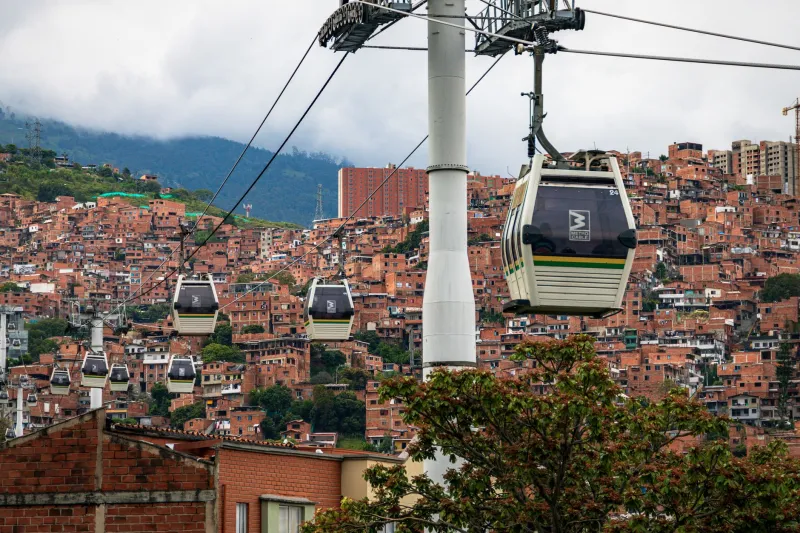
And then there's the city itself. Medellín appears in this cinema not as spectacle but as lived environment — a place with a specific texture, a specific light, a specific emotional temperature. These directors grew up here. They know which streets feel like safety and which ones don't. That knowledge shows.
What US Audiences Are Missing
Here's the honest truth: most American moviegoers have no idea this work exists. The pipeline from Colombian film festivals to US arthouse theaters is narrow, and streaming platforms have been inconsistent about acquiring and promoting Latin American films beyond the most commercially obvious picks.
But the appetite is there. American audiences who've discovered this cinema through festivals — Sundance, SXSW, the New York Film Festival — have responded with genuine enthusiasm. The critical reception has been strong. What's missing is the marketing muscle to turn that festival buzz into broader cultural conversation.
That's part of why platforms like this one exist. Medellín The Film isn't just about celebrating what's already famous — it's about making sure the work that deserves to be seen actually gets seen.
The Next Wave
The directors making noise right now are already mentoring the filmmakers who'll define Colombian cinema a decade from now. Film programs in Medellín and Bogotá are producing graduates who've grown up watching Laura Mora win at San Sebastián and thinking: that's possible. That's something I can reach for.
The revolution isn't coming. It's already in production.
And honestly? We can't wait to see the cut.